Specify the effect
Write down the model, its competing explanations, and the measurements that could prove it wrong.
Tomorrow, Tested · Proposed research track
A spacecraft concept becomes a technology only when its underlying effects survive measurement, independent checks, and engineering limits. Quaternion Pathfinder is our route from an ambitious idea to that decision.
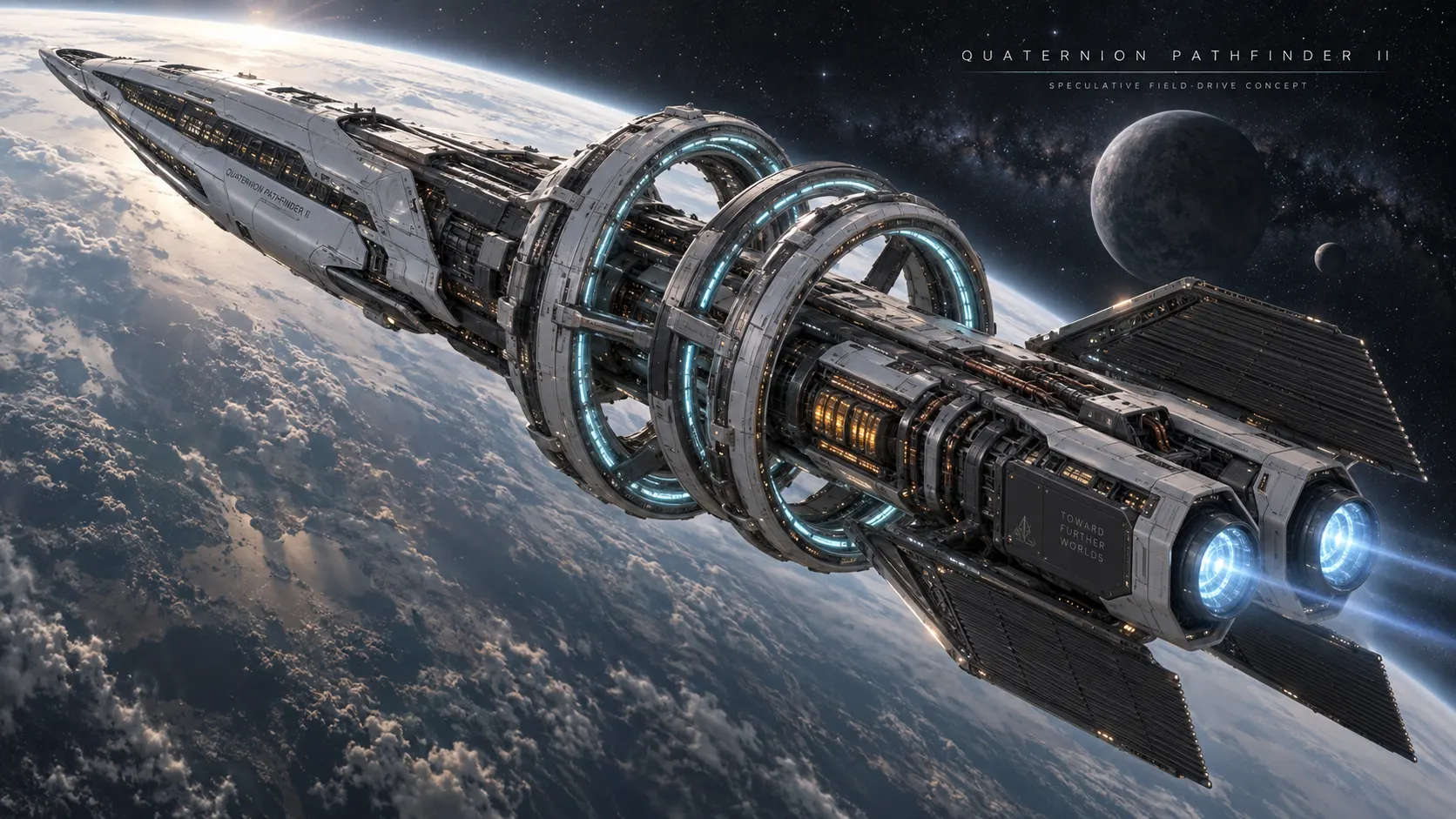
Pathfinder II concept artwork. This image shows a proposed direction, not measured hardware or a canonical experiment result.
Programme vision · 15-second concept film
A cinematic glimpse of the ambition behind the research.
A reconstructed 3D Pathfinder II floats in space with a cloud-covered planet behind it. The rings and twin aft emission cells start dark. A quiet string-like opening fades before the first ring activates. The camera moves continuously closer as three rings light up in sequence, accompanied by rising engine tones. Moving light travels through metal-bordered channels along the hull into the emitter housings, and the emitters brighten. A low departure impact accompanies the craft accelerating away from the planet into open space, leaving a fading blue wake. The film ends on the planet and stars. All sound is original synthetic sound design, not recorded engine behaviour. The reconstruction interprets the hero artwork; it does not reproduce every detail of that image.
This optional version adds spoken visual descriptions over a quieter soundtrack. It holds the final black frame for three extra seconds so the description can finish.
The mission
The goal is to test the propulsion ideas, follow effects that survive physical measurement, and develop a buildable demonstrator only when the whole system can be accounted for.
Write down the model, its competing explanations, and the measurements that could prove it wrong.
Use calibrated physical tests and controls to distinguish a real effect from heat, vibration, ordinary radiation recoil, or numerical error.
Close the power, heat, mass, control, and failure budgets before making a technology claim.
From idea to demonstrator
PF-001 has a canonical result for its registered scalar model. Later stages remain proposed investigations, each requiring its own pre-registration and evidence. A successful calculation does not establish a physical propulsion technology.
Inspect PF-001: result, margins and original evidence
When a spacecraft sends radiation in one direction, it receives a small push in the other. The first Pathfinder study asks whether changing the timing between two emitters can steer that push in a mathematical model. It must also account for all the energy and momentum, including what happens close to the emitters. A calculation that balances is a useful model result, not proof that a new engine works.
A separate idea proposes changing how an object's motion responds to force. That is the modified-inertia branch, and it needs its own physical mechanism and measurements. Quaternion mathematics helps describe orientation; it does not, by itself, create thrust.
PF-001 revision 1: accepted within the scalar model
Does steering the phase of two emitters change recoil while the complete energy and momentum account closes?
Evidence needed: Finite-source simulation, independent force and flux calculations, reversal controls, and convergence checks.
Planned research
Can a calibrated electromagnetic bench test resolve the predicted force and directional radiation pattern?
Evidence needed: Power, angular output and force measurements with thermal, vibration, pickup and phase controls.
Requires a physical mechanism
Is there a specified, measurable interaction beyond established electromagnetic radiation?
Evidence needed: A physical coupling proposal, distinguishing prediction, calibrated controls, and independent replication.
Separate conditional branch
Does any measured system follow the proposed change in the momentum-velocity relation?
Evidence needed: A physical control state, conventional competing prediction, energy account, and repeatable measurement.
Conditional on measured effects
Can a measured effect be powered, cooled, controlled, and packaged with useful performance margins?
Evidence needed: Subsystem maps, mass and heat budgets, fault behaviour, repeat runs, and design review.
Long-term goal
Does an integrated test article perform within its declared operating envelope?
Evidence needed: Build records, instrumented ground tests, anomalies, independent review, and reproducible performance data.
The radiation-recoil work and the proposed modified-inertia effect are separate branches. A result in one cannot establish the other. If a branch fails, its negative result stays in the record and the build path changes.
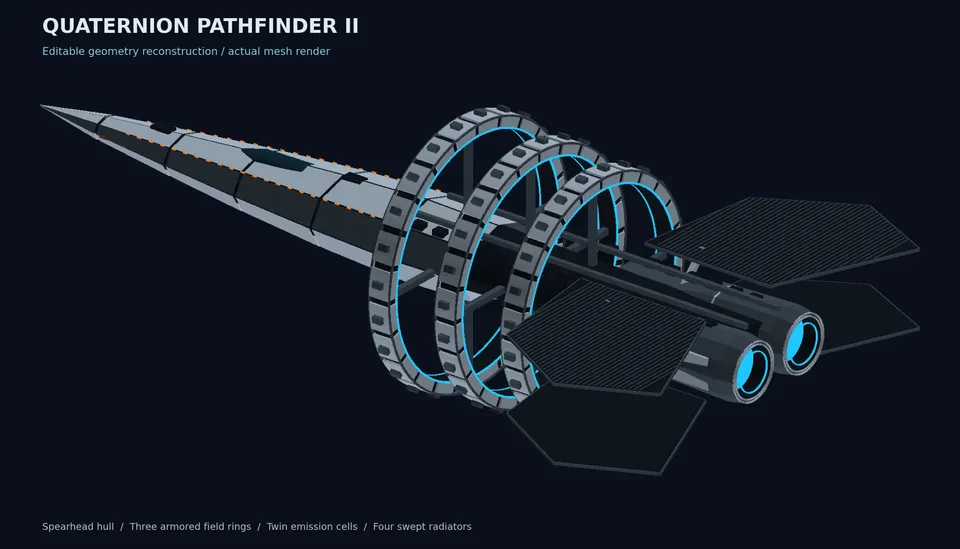
Pathfinder II · Editable concept geometry
The rings, emitters, energy banks, and radiators make the research questions visible. Their shapes and sizes are artistic choices. As experiments progress, measured requirements can replace those assumptions.
The current mesh is an editable surface reconstruction, with no validated propulsion hardware, interior, or manufacturing tolerances.